


Are you questioning why market timing doesn't work? Or asking yourself - What’s the big deal if I miss a day or two of stock market trading?
Missing only a few days of strong returns can drastically impact your overall performance. If you want the best chance at positive returns, you can't afford to sit on the sidelines when the stock market is trading. The chart below is one of my favorite charts to show clients. It shows the performance of the S&P 500 Index over a timeframe of around 27 years. As a financial advisor in the Westchester/Fairfield area, where many of my clients reside, investors are constantly bombarded by sales pitches touting superior returns of particular funds. Let’s assume these performance numbers are completely truthful, what we still will never know, with any degree of cert
ainty, is how much of that return was achieved by skill and how much by pure dumb luck. But that’s a topic for another discussion…
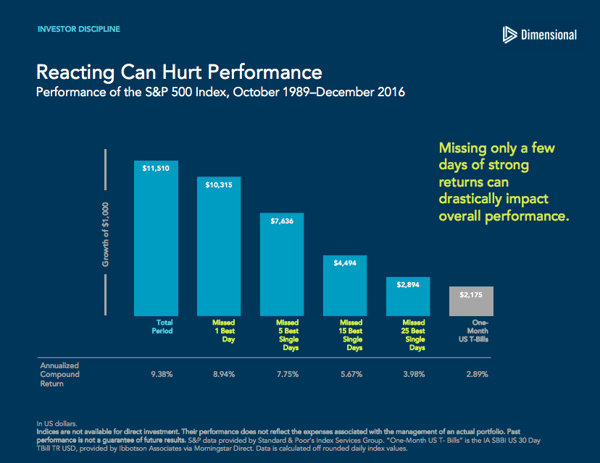
Let’s get back to this powerful chart from above. If we start with the basic idea of investing $1,000 in the S&P 500 on October 1, 1989—and doing absolutely nothing until checking its growth at the end of December 2016— I think we’ll be fairly pleased. This $1,000 has now grown to $11,510 by recognizing an annualized compound return of 9.38%. Not bad!
But here’s where it gets interesting. What happens if instead of doing nothing we decide to go in and out of the market based on what we think are “good times” and “bad times” to participate? If we missed participating in the 5 best single days of trading in that approximately 27 year period of time, our annualized return would have dropped to 7.75% and our $1,000 would have grown to only $7,636. Wow! But let’s get even more extreme. If we missed the 25 best single days of trading, our annualized return would drop all the way down to 3.98%, not all that much more than if we had gone with the super safe option of One-Month US T-Bills which returned 2.89% over that time frame.
So, the single most important message here is that a huge amount of the market’s return is delivered in an incredibly few trading days. Missing just a few of them will be very damaging to your financial health.
Why Market Timing Doesn't Work
What’s the solution? After deciding the right percentage of your long-term portfolio to commit to the broad stock market, leave it alone!! You might be asking, “What happens if we’re out of the market on a few of the worst days?” Not surprisingly the opposite is true in that your returns will be phenomenal. Maybe I’ll do a future blog on these specific numbers too. However, let’s be honest. When we start to play this market timing/predicting game, aren’t we just gambling with our life savings?
It’s difficult enough to keep your emotions and behavior in check with a beautifully constructed long-term investment portfolio when stock markets as a whole simply aren’t cooperating—which happens frequently—let alone trying to consistently outsmart millions of market participants who are putting in huge amounts of time, effort and expense into their own strategies. Once you can get past the idea that achieving superior long-term investment results doesn’t require anything more than a whole lot of common sense, patience and self-discipline, you’ll be well on your way to success. Study the chart one more time. Its message is powerful.


